Agricultural drones and agricultural robots solve different problems. Drones own the air: spraying, seeding and crop monitoring. Robots work the ground: weeding, harvesting and precise in-row work.
On this page
As of 2026, drones are the fastest-growing segment of agricultural automation, holding roughly 46.5% of the market, because they deliver quick and visible ROI on spraying. Ground robots are the emerging frontier, growing at over 20% CAGR as labour shortages push farms toward full autonomy. For most farms the practical answer is not one or the other — it is both, working as an air-ground system.
Head-to-head comparison
| Dimension | Agricultural drone | Agricultural robot |
|---|---|---|
| Working space | Air — above fields and orchards | Ground — between rows and beds |
| Core tasks | Spraying, spreading, mapping, scouting | Weeding, harvesting, carrying, precise in-row application |
| Throughput | One operator covers large acreage per day | Continuous operation, hour after hour |
| Typical investment | Lower entry point | Higher upfront investment |
| ROI speed | Fast — first-season payback is common | Medium to long — typically 3–5 years |
| Technology maturity | Mature — mainstream in 2026 | Emerging — growing at 22–25% CAGR |
| What it replaces | Field management labour | Heavy repetitive field labour |
When to choose a drone
- Large-area crop protection. Spraying and spreading over fields that would take a ground rig days — and over ground a rig cannot enter without damage.
- Crop scouting. Multispectral scanning can flag disease and stress days before it becomes visible from the cab.
- Emergency response. Disease outbreak or a break in the weather: the aircraft is airborne in minutes.
- Limited budget, fast payback. The lowest entry point into agricultural automation, and the fastest route to a demonstrable return.
When to choose a robot
- Weeding. Machine-vision recognition targets weeds specifically, which in trials cuts herbicide volume dramatically compared with blanket spraying.
- Harvesting. Fruit and vegetable picking robots address the single most labour-intensive task on many farms.
- Continuous work. Robots do not tire — they take over the repetitive, heavy work that is hardest to staff.
- Long-term strategy. Where agricultural labour is structurally shrinking, ground autonomy is the durable answer — but it is a multi-year investment.
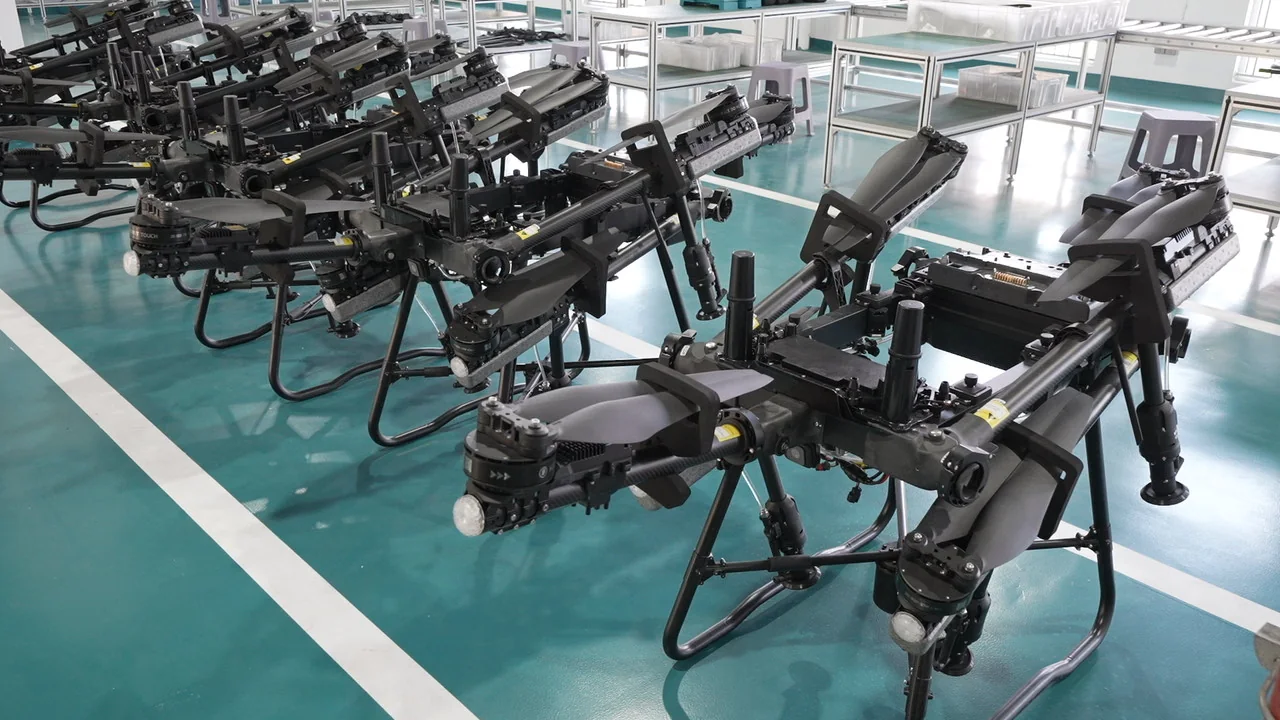
Ground autonomy is already real on the factory side, even where it is still arriving in the field. The constraint on a robot fleet is no longer whether the machines can be built — it is whether they can be built in volume, to a repeatable standard:
The numbers
- The agricultural robot market is projected to grow from roughly $26 billion in 2026 to $57 billion by 2030, a 22% CAGR (The Business Research Company).
- Drones account for about 46.5% of that market — the single largest segment (Fortune Business Insights).
- Precision agriculture lifts fertiliser use efficiency by 15–20% (USDA).
- Roughly 66% of US farms already use GPS-based yield monitoring (Iowa State University).
Why air-ground is the real answer
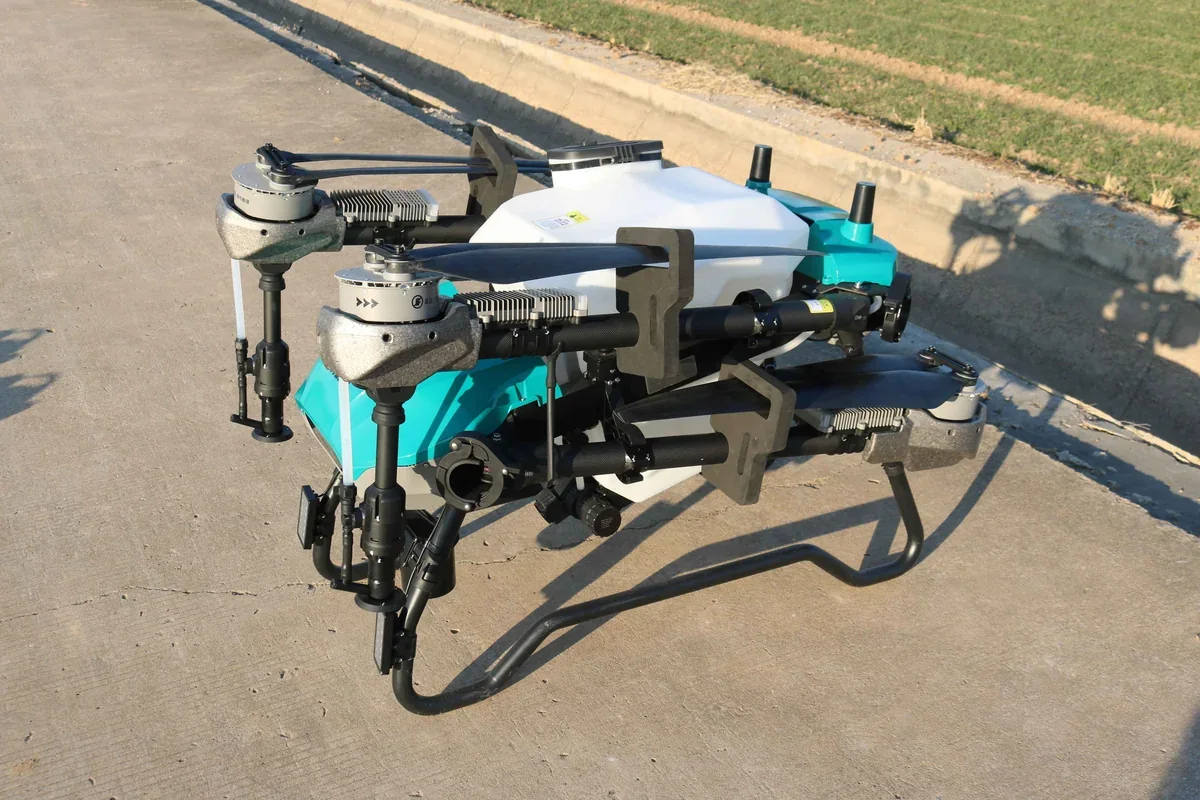
Instead of making farmers choose, the practical systems combine both. Drones handle what is hard to reach from the ground; navigation and ground machines handle what needs precision at ground level:
| Job | Machine | Key specification |
|---|---|---|
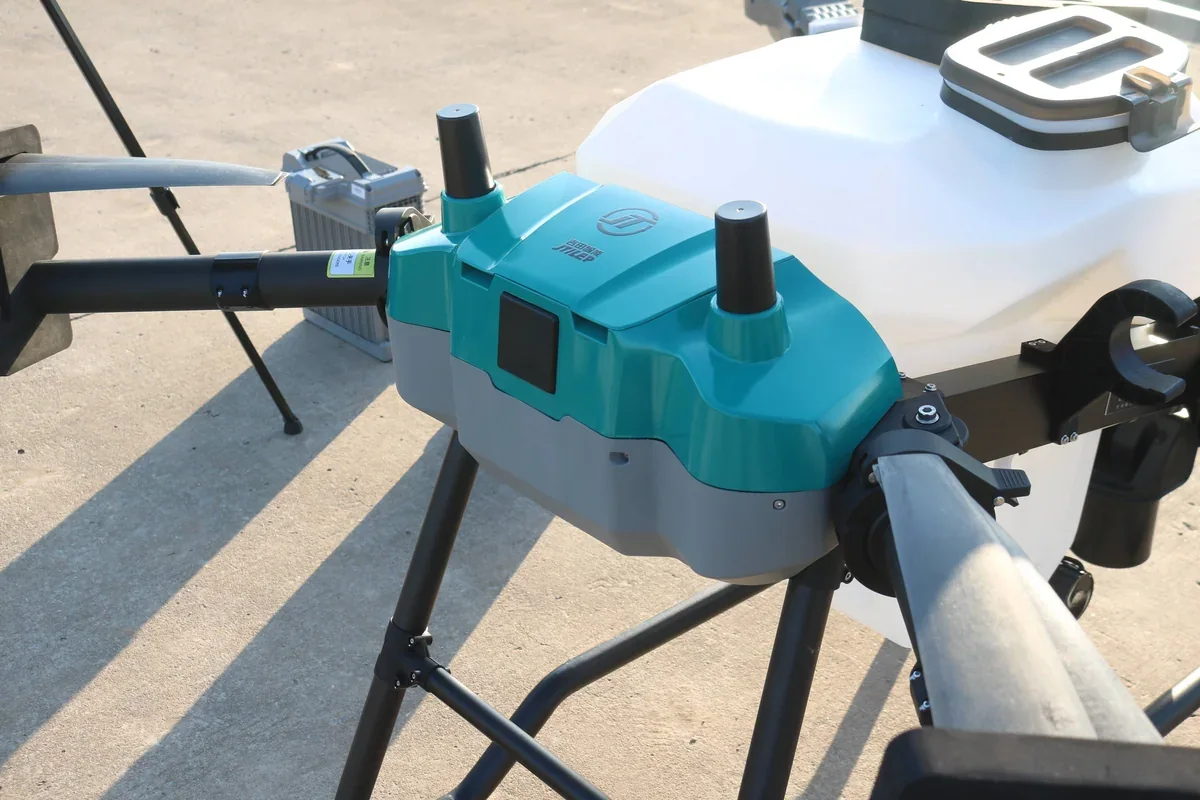
| Aerial crop protection | JT-80 drone | 70 L spray / 100 L spread · 150 kg max take-off · radar detection to 50 m · IP67 |
| Aerial spreading | JT-80 with Jiaolong spreading disc | Metered granular application through the 100 L hopper |
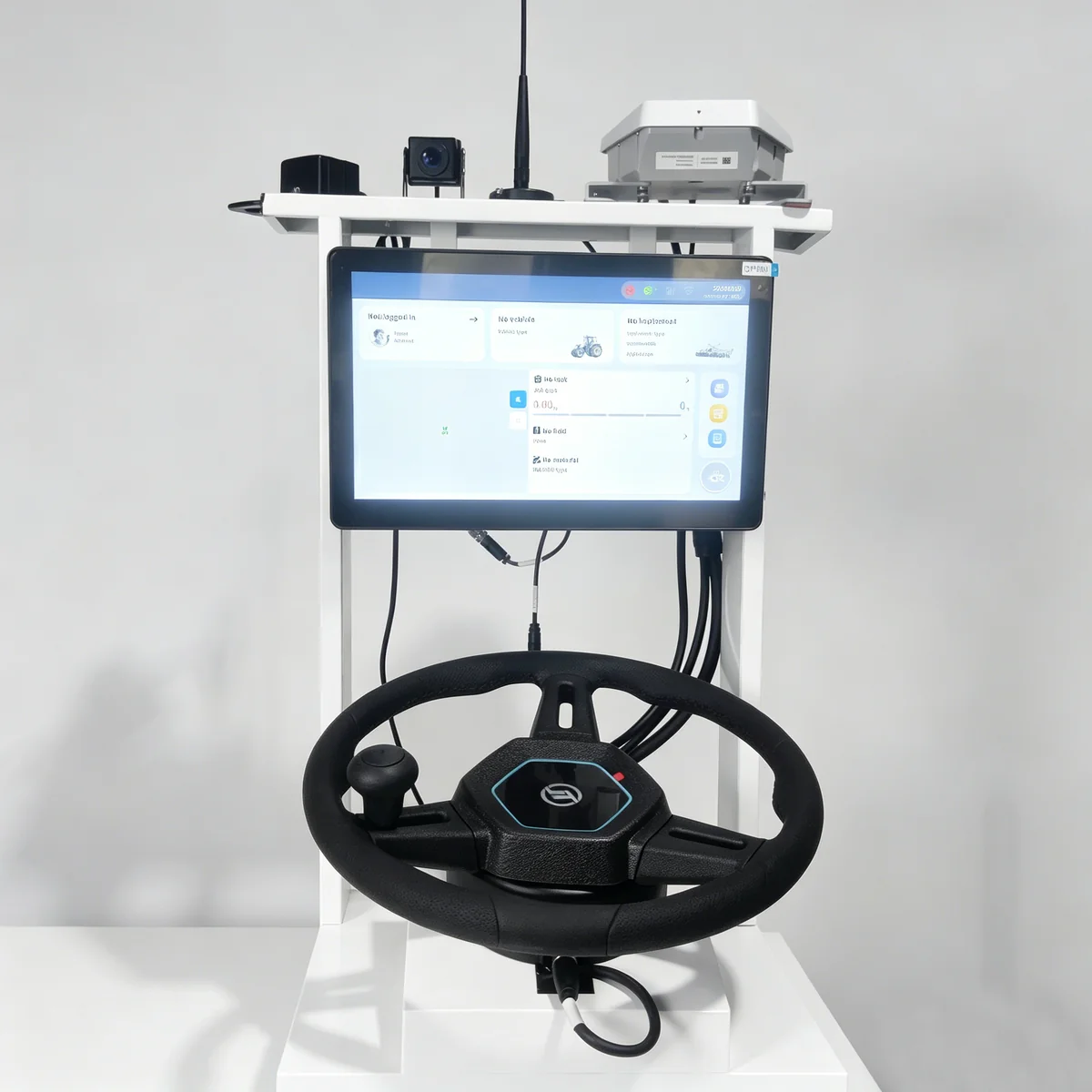
| Ground precision work | HD818 auto-steering | BeiDou + GPS + GLONASS + Galileo · ±2.5 cm RTK · one-click headland turn · ISOBUS |
| Future | Agricultural robots | Vision + laser + millimetre-wave sensing · autonomous decisions · fleet coordination (roadmap) |
Why the combination wins: the drone solves "out of reach" (aerial spraying and monitoring) while navigation and ground machines solve "not precise enough" (in-row work). The data flows between them — aerial survey to prescription map to precise execution — which closes the loop. A farm that buys only one half still gets value; a farm that buys both gets compounding value.
Jitian Intelligent builds both halves in the same plant: the JT-80 drone and the HD818 auto-steering kit share one supply chain, one contact and one document set, with FCC and CE-EMF certification for the platform and further market documents handled case by case.
A three-question decision framework
- What is your biggest bottleneck? Slow spraying → drone. Expensive or scarce weeding labour → robot. Crooked rows and wasted seed → auto-steering.
- What payback horizon can you accept? If you need returns in the first season, automate the aerial or navigation layer. If you can invest over three to five years, the ground-robot route opens up.
- Which market are you supplying? For emerging markets, drones and auto-steering offer the strongest combination of price, proven performance and available certification. For mature markets, ground robotics is worth planning ahead for — but not yet buying on promise.
Frequently asked questions
Can a drone replace an agricultural robot?
No. A drone cannot do in-row weeding or harvesting, and a robot cannot cover large acreage from the air. They address different constraints, which is why combining them produces better results than either alone.
How much does an agricultural robot cost?
Ground robots remain a significant capital investment — substantially more than a spray drone or auto-steering kit. The relevant question is not which is cheaper, but which one solves a problem you actually have. Robots earn their cost where labour is genuinely unavailable, not merely expensive.
What is the fastest ROI in agricultural automation?
Crop protection drones and tractor auto-steering. Both deliver first-season returns on most farms, because both directly cut input waste and labour. Ground robot payback is typically measured over three to five years.
Ready to build your air-ground system?
Jitian Intelligent supplies both halves: the JT-80 drone for spraying and spreading, and the HD818 auto-steering kit for centimetre-level ground work — with an agricultural robot roadmap behind them.